To begin with - a sobering chart from our friends at Committee for a Responsible Federal Budget.

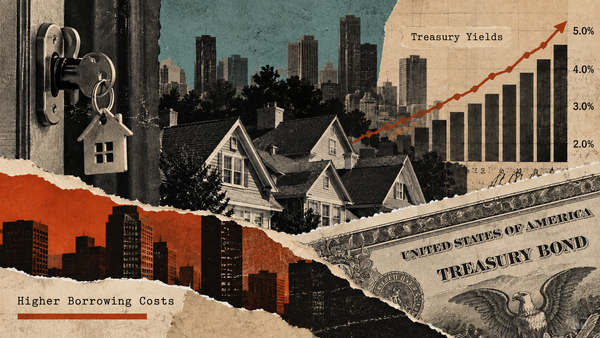
Bond yields are climbing. For those who aren't glued to MSNBC, increasing yields show diminishing demand for US treasuries - not great news for the US economy as a whole.
But that's far from the worst news.
The bond yield is basically the interest rate on government debt. As it rises, the cost for the US to finance new debt or roll over old debt grows.
If the interest rates grow and remain higher than the rate of growth in the economy as a whole (R > G), the US can reach a situation where we have to borrow money even if the primary deficit – revenue minus all expenses except interest - is balanced.
And by the way, the primary deficit is nowhere near balanced!
Whenever that happens (and our friends are calling for it potentially within about 36 months), the US formally enters into a debt spiral, paying for debt with debt. When that happens, it is very likely to the US will also have to pay more to borrow (i.e., higher interest rates), accelerating the issue.
Interest Lack: Are Debtniks Crying Wolf?
On a recent episode of his podcast Interesting Times, Ross Douthat asked his guest Ray Dalio whether the national debt is a real problem or a politics problem.
I am 46 years old. I have lived my entire life in the shadow of predictions about the U.S. deficit being unsustainable. The first presidential election I really remember is Ross Perot’s campaign in 1992, which was run in part on those themes.
But like a lot of Americans, that means that I tend to tune out the deficit argument . . . . Why are the 2030s or the late 2020s different from the last 20 years, when we’ve also had these deficits?
Douthat's question reflects what so many on Capitol Hill say when the rising debt is pointed out to them. We've been told since the 90s that the debt was an existential threat. In 2010, the Tea Party rode to victory on a promise to restore fiscal discipline to the country, lest it crumble under the weight of the debt.
No such discipline came, and here we still are.
Dalio's answer, while fair, ignored something crucial. In the 2010s, as the Tea Party was gaining prominence by criticizing deficit spending, there was a period of recession-driven low rates. So while the debt exploded from 2000-2010, interest payments decreased.
They cried wolf, won an election, and the prophesied disaster never came.
CRFB's chart shows what happens when the cycle works the other way. Policymakers got lulled to sleep by a forgiving economic cycle, which just happened to confirm their short-termism and populist campaign rhetoric.
The other side of the cycle will punish even small mistakes more harshly – let alone the tail tucking currently on display in Washington. Ironically, what allowed us to run huge deficits without negative consequences a decade ago will cause even tiny ones to be way more destructive.
What do we do?
The largest drivers of US debt are also the programs whose reform is most unpopular, with the most entrenched special interests involved.
If Congress decides to get serious about solving it, every state needs to prepare for drastic renegotiations of their relationship to federal funding.
If legislators continue to avoid all painful choices, then every citizen should prepare for a long-term stagflationary scenario where growth is hobbled even as prices rise.
Old assets with rates locked in will increase in value.
Meanwhile, because treasury rates are the base rate for all debt in the economy, new assets, like home purchases, become even more difficult to acquire. Every additional point increase in rates means a mortgage payment goes up by roughly 12% per month.
All while cash leaks its value like a punctured balloon.
Do not put your head in the sand. Do not over-leverage. Fight spending with everything you've got, and use every bit of margin you can uncover to invest proactively against the future Congress is steering towards.
Then, insist that they start turning the wheel.