Widespread protests in Paris over pay, schools, and public services are colliding with a stark reality: a 122% debt-to-GDP ratio and nearly €100 billion in interest payments, offering a preview of the fiscal arithmetic that may soon catch up with the United States.
The protests under way in France are not simply a fiscal crisis in disguise, but they're not not that.
Students have real grievances about school conditions, while public-sector workers are contesting wages, staffing, and service quality. But the public-finance dimension is hard to miss. French general-government debt reached 119.0 percent of GDP in Q2 2026; the government’s 2027 budget projects debt near 122 percent, a 5 percent deficit, and €91.2 billion in annual interest expense. Nearly every major demand is therefore being made against a shrinking fiscal margin.
The student demands are largely claims on public capacity. Protesters cite teacher and staff shortages, overcrowded classes, deteriorating buildings, long school days, and unequal access to higher education; unions supporting them also oppose Parcoursup and emphasize youth precarity. More teachers and staff mean higher recurring payrolls; smaller classes generally require more personnel and sometimes more physical capacity; and school repairs require capital spending. Greater student aid would mean higher transfers, while loosening university admissions constraints would also carry fiscal consequences if accompanied by enough places, instructors, and facilities to absorb additional students.
The labor demands are even more explicitly connected to public finance. Public-sector unions have called for increases in the civil-service salary index, inflation protection, full sick-leave pay, stronger staffing, and more resources for public services. The broader inter-union platform now includes higher pensions and social benefits, a higher minimum wage, additional climate and transit investment, and more funding for health, education, and elder care. It proposes financing part of this through higher taxes on wealth, inheritances, and dividends and by reevaluating business subsidies. The minimum-wage demand is primarily regulatory; the others either increase expenditure, redirect existing expenditure, or increase revenue.
France, however, is already attempting substantial consolidation. The 2027 budget proposes €54 billion of adjustment, including restraints on pensions, health spending, local government, and public compensation. The IMF argues that France already has one of the euro area’s highest revenue burdens and its highest public-spending ratio, limiting the scope for further tax-led adjustment. Rising interest expense narrows the room further. Fiscal capacity is therefore not the same thing as government size: a large state can still have very little discretionary room.
Euro membership sharpens the constraint. France does not lack a currency; it shares one. But the ECB sets monetary policy for the euro area, while EU law prohibits direct central-bank financing of member governments. Paris cannot independently cut rates, devalue a national currency, or monetize borrowing in response to a specifically French squeeze. The ECB can counter disorderly market fragmentation through instruments such as the TPI, but those facilities are intended to preserve monetary-policy transmission and are subject to fiscal-sustainability criteria; they are not mechanisms for removing underlying budget constraints.
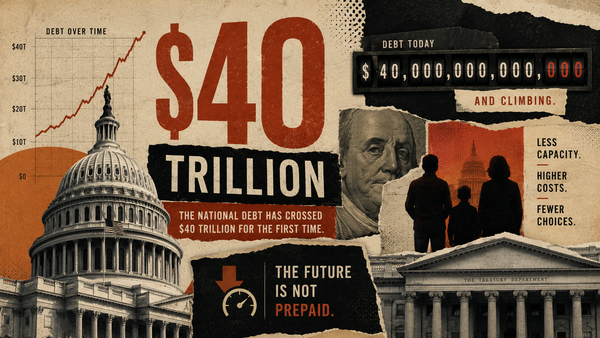
That is the caution for the United States. CBO projects federal debt held by the public at 101 percent of GDP in 2026 and 120 percent by 2036. WhileFrance does not prove that high debt mechanically causes protest, it does illustrate that as debt service and prior commitments absorb more revenue, ordinary political disagreements increasingly become zero-sum disputes over who must bear adjustment.
The United States possesses greater monetary autonomy than France, although the Federal Reserve independently conducts monetary policy under its price-stability and employment mandates. That institutional difference matters, but it does not exempt the United States from the underlying fiscal arithmetic.
The danger is not that America will reproduce France’s politics in precisely the same form. It is that continued erosion of fiscal capacity leaves fewer ways to reconcile legitimate public demands – to say nothing of illegitimate demands and grift – without imposing increasingly visible costs on someone else. If that happens, history offers more than just this current episode as a lesson about what will happen.