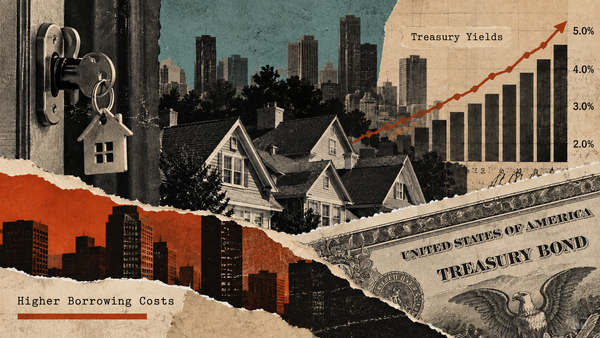
The rise in long-term U.S. Treasury yields is part of a broader global repricing, not an isolated American event. Government borrowing costs have risen sharply across the United States, Japan, Britain, France, Germany, and other advanced economies. The average G7 10-year yield recently reached its highest level since the 2008 era. That matters because it suggests that the Treasury selloff cannot be reduced to a uniquely American loss of confidence.
But the global nature of the move is not an exculpation for fiscal policy. It may be the opposite. The world is repricing debt-laden sovereigns together: countries with large refinancing needs, rising defense and infrastructure demands, aging populations, and electorates reluctant to accept either substantial tax increases or substantial spending restraint. Inflation risk and tighter monetary policy provide the immediate spark. The deeper issue is the price investors now require to hold a large and growing stock of long-dated government obligations.
That is why the phrase “global repricing” should not become a substitute for analysis. Different countries enter this environment with different debt burdens, political capacities, currency arrangements, and growth prospects. The United States retains exceptional advantages: the dollar remains the principal reserve currency, Treasuries are central to global finance, and American capital markets remain unusually deep. Secretary Scott Bessent is right to point to the strength and resilience of the U.S. economy, rather than treating every rise in yields as a referendum on national solvency.
Still, those advantages buy time and room for adjustment; they do not repeal fiscal arithmetic. Howard Marks has emphasized the unusual nature of running deficits near 6 percent of GDP in an economy that is not in recession. If debt grows faster than GDP, the interest bill takes a larger share of the budget even with rates held constant. When rates rise as well, the problem compounds.
This is also where the Congressional Budget Office’s baseline needs to be read properly. Its forecasts are not predictions immune to changed financial conditions; they depend explicitly on a path for interest rates. In February, CBO projected the average 10-year Treasury rate at 4.1 percent in 2026 and 4.3 percent in 2029, while acknowledging a wide uncertainty range. The market’s recent move above 5.3 percent does not, by itself, prove the annual forecast wrong—but it is already materially above the central path on which the baseline rests. CBO had also already raised its long-term-rate forecast relative to the previous year.
The sensitivity is not abstract. CBO estimates that interest rates just one-tenth of a percentage point higher than its forecast in every year would add roughly $379 billion to cumulative deficits over 2027–2036, including the added borrowing needed to pay the added interest.
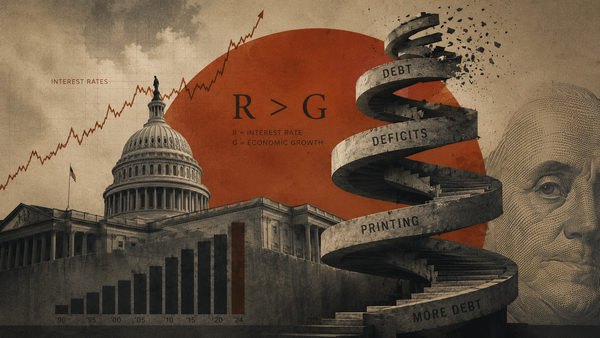
This is the debt-spiral mechanism: higher yields raise refinancing costs; higher interest costs enlarge deficits; larger deficits require more borrowing; and more borrowing leaves the budget more exposed to the next rate increase. It need not become a crisis to become a governing constraint. The warning from the long end is not that disaster is certain. It is that fiscal capacity is becoming more contingent on conditions policymakers do not fully control.