An increasing share of America's future has already been spoken for. And the problem is speeding up.
The United States has crossed another fiscal threshold: gross federal debt has surpassed $40 trillion. It took two nearly two centuries for the US to be add a full trillion dollars to the debt. How fast did it add the most recent trillion? 5 months.
That's about $75,000 a second. One typical American household's annual income. In a second. Every second. Federal debt has doubled over the past decade and quadrupled in less than 20 years, but the rate is increasing at a rapid pace.
The milestone is therefore less important as a round number than as evidence of a deteriorating fiscal trajectory.
What Does $40 Trillion Actually Measure?
The headline number is gross federal debt, which includes both debt held by the public and debt the federal government owes to its own accounts and trust funds.
Roughly $32 trillion is held by investors or the Federal Reserve, while another $7.8 trillion represents intragovernmental obligations, including obligations to programs such as Social Security. Debt held by the public has the more immediate relationship to financial markets and borrowing costs. But intragovernmental debt represents real federal commitments as well.
Neither number should be confused with a literal bill divided among American households. Federal debt affects families primarily through the economic conditions created by persistent government borrowing.
That distinction becomes increasingly important as the debt grows.
The More Troubling Number Is the Speed
Earlier this year, the Congressional Budget Office projected that federal debt would finish fiscal year 2026 at roughly $39.5 trillion. Instead, the government crossed $40 trillion with approximately six weeks remaining in the fiscal year. CBO has also increased its projection for this year's deficit from roughly $1.9 trillion to $2.1 trillion.
Some developments accelerated the timetable this year. Revenue assumptions changed. Spending exceeded earlier expectations. Higher interest rates increased the cost of servicing existing debt.
But temporary surprises do not explain the underlying problem.
Federal spending is increasingly driven by programs that operate largely outside the annual appropriations process, especially Social Security, Medicare and Medicaid. At the same time, demographic changes are increasing the number of beneficiaries relative to the workers financing those programs. Interest then compounds the problem: larger primary deficits (revenue minus spending excluding interest) create more debt, and more debt creates larger interest payments.
That is why eliminating waste, fraud and abuse, while worthwhile, cannot by itself solve America's fiscal problem. The imbalance is structural.
Interest Makes the Problem Self-Reinforcing
Federal borrowing does not work like a homeowner's fixed-rate mortgage. Treasury securities continually mature and are refinanced through new borrowing. As a result, higher prevailing interest rates gradually work their way through the government's debt portfolio.
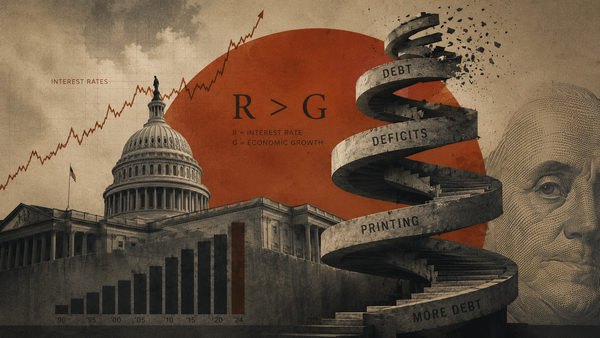
The combination of rising debt and elevated rates therefore creates a dangerous feedback loop: deficits increase the debt, the debt increases interest costs, and those interest costs contribute to future deficits.
This is one reason fiscal deterioration can accelerate even without a dramatic new spending program (though there are plenty of new programs also being offered in an election year).
That vicious cycle is also why the consequences don't remain in Washington.
Federal Debt Eventually Reaches the Household Budget
The federal government is the largest borrower in the American economy. In fact, treasury securities provide the main benchmark against which other forms of credit are priced.
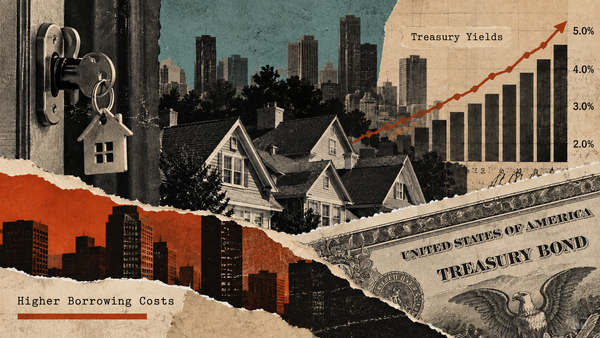
When government borrowing costs remain high, households and businesses encounter those conditions elsewhere. Mortgage rates reflect Treasury yields plus compensation for additional risk. Businesses face higher financing costs when borrowing to expand, purchase equipment or make other investments.
And if investors see added risk premium on US debt, they can demand more even when the Fed cuts rates (see the chart below - over the last two years, the Fed has cut rates by nearly 2%, during which time the 10-year rate has increased by 1%).
For every additional percentage point on interest rates, the price of a mortgage goes up 15%. For the average Tennessean homeowner, that adds about $3,700 per year to their costs.
That's before you add in the elevated costs of everything else when businesses face the same headwinds that homeowners do, and those problems scale more efficiently.
But the affordability conversation, which has reached fever pitch in the last two years, is an interest rate conversation, which means it is a national debt conversation.

Over time, as US debt interest becomes the largest item on the federal budget, all investment will be harder to do. Less investment means less productive capacity, weaker wage growth and fewer opportunities for future workers.
Federal government spending is increasingly stuck on the past, and the future is asking questions.
This is the deeper problem represented by the $40 trillion headline. It is the path more than the amount - and the speed at which we're going.
The danger is not simply that America owes $40 trillion. It is that an increasing share of America's future has already been spoken for.
A Credible Fiscal Strategy
There is no painless solution. But delay makes the available solutions worse.
A serious fiscal strategy should begin by establishing a credible path toward reducing annual deficits to approximately 3 percent of GDP, eventually stabilizing debt relative to the size of the economy. It should address the major mandatory programs before trust-fund exhaustion forces abrupt changes. Major tax reductions or spending expansions should be financed rather than simply added to the debt. And both spending and revenue should be available for negotiation rather than allowing either side of the federal ledger to become politically untouchable.
Just as important, fiscal restraint should distinguish between consumption and investments that expand future productive capacity. Economic growth is indispensable to restoring fiscal health, but growth cannot substitute indefinitely for responsible budgeting. Nor can austerity produce prosperity if it destroys the foundations for future growth.
The objective is not simply a smaller number on Treasury's balance sheet.
It is fiscal capacity: enough flexibility to honor essential commitments, respond to crises and invest in the conditions of future prosperity.
The $40 trillion milestone should therefore be understood as a warning. America's fiscal problem is not new. What has changed is the speed at which it is worsening.
The headline is $40 trillion.
The problem underneath it is the steady erosion of America's room to choose its future.